
Master Teen Patti · Game guide
999 Teen Patti – Rules & How to Play
999 is a Teen Patti variant name associated with a three-digit scoring objective. The exact card-value mapping, permitted order and comparison rules need to be read from the selected table. This page explains what to check, without treating the label as a complete rule specification.
Version 1.0 · 58.1 MB · Android 5.0+ · File information
Master Teen Patti
999 Teen Patti
The game at a glance
Rule illustrations, not screenshots of the downloadable app.
How to play 999 Teen Patti
- Read how the table assigns values to aces, numbered and picture cards.
- Confirm how three card values form a score or target.
- Check whether card order may be changed.
- Read the betting, fold and show conditions.
- Compare the hands with the stated scoring and tie rule.
Rule example
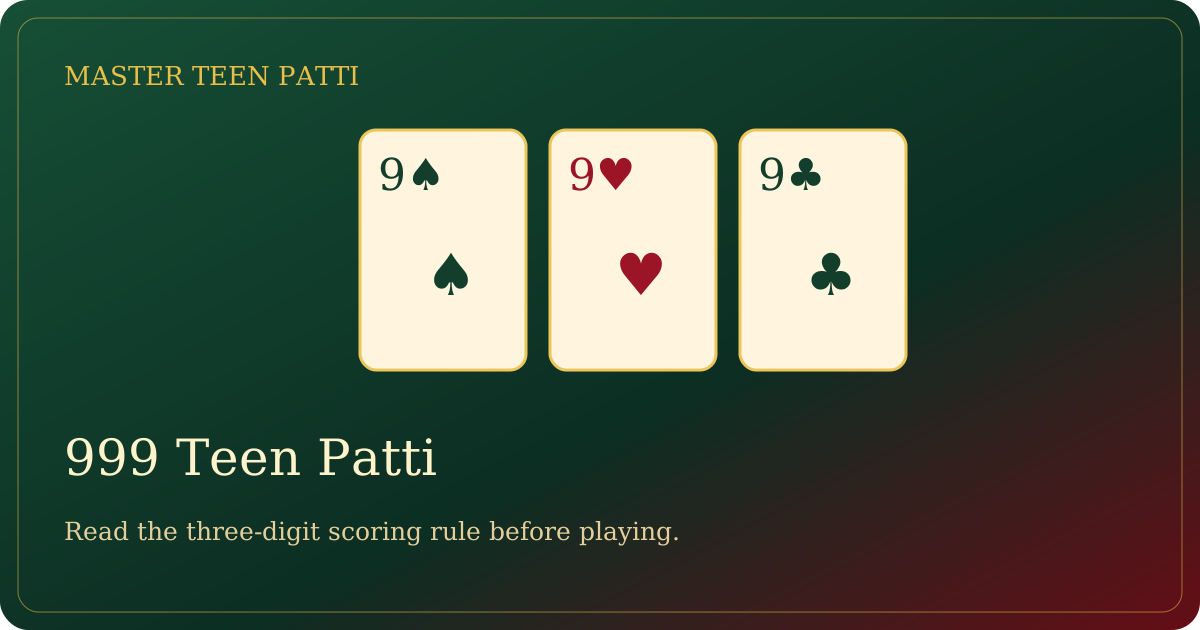
Three nines illustrate the 999 target. Before comparing another hand, check its card-value mapping and whether arrangement of the three values is allowed. Classic hand categories are not automatically the scoring rule.
Hand rankings
| Scoring check | What to read |
|---|---|
| Card values | Confirm the table’s mapping for aces, numbers and picture cards |
| Arrangement | Check whether the three values may be reordered |
| Comparison | Confirm the target and comparison direction |
| Ties | Read how equal scores resolve |
Teen Patti variants
AK47 Teen Patti
Aces, kings, fours and sevens as wild cards. Read the guide →
Muflis Teen Patti
A low-hand variation: rethink the ranking. Read the guide →
Joker Teen Patti
Read the wild-card rule before the deal. Read the guide →
999 Teen Patti
Read the three-digit scoring rule before playing. Read the guide →
Hukam Teen Patti
A declared suit can change card evaluation. Read the guide →
Tips before the table
- Read the scoring card before using a familiar ranking.
- Keep an example of the target and tie procedure nearby.
- Check wild cards separately; the name 999 does not establish them.
- Learn a new scoring system in practice before accepting financial exposure.
Tables, stakes and timers
Entry amounts, turn timers, pot limits and disconnect rules depend on the selected table. Check these before joining and note how the table handles a timeout. This guide does not set or verify the APK’s financial limits. No bet size removes the possibility of loss.
How to check fairness
Random outcomes cannot be validated by the appearance of a hand or a short winning streak. A fairness claim requires verifiable evidence from an identified operator. No independent RNG report has been supplied for this APK. Keep a record of an unresolved round and use a verified product support channel.
Common mistakes
- Applying Classic rankings without reading the variant rule.
- Assuming picture cards have a value copied from another table.
- Ignoring the order or arrangement rule.
- Treating a high score as a guaranteed result.
999 Teen Patti glossary
- Boot
- The agreed opening contribution before cards are dealt.
- Chaal
- The contribution made on a turn to stay in the round, under the table’s blind/seen rules.
- Blind
- Play without viewing the hand. Seen play means the cards have been viewed.
- Side show
- A permitted private comparison between eligible players; its conditions depend on the table.
- Pot limit
- A table-defined cap. Check how the chosen table ends a round when the cap is reached.
999 Teen Patti FAQ
What must a 999 scoring rule explain?
It must define the card-to-value mapping, how the three values may be arranged, what result is preferred and how equal results are resolved.
Can I apply the Classic six-category chart to 999?
Not automatically. A three-digit scoring variant needs its own scoring rule. Do not treat the variant name alone as permission to replace its scoring with trail-to-high-card ordering.
Is this mode confirmed in the APK?
These are general game guides. The linked APK has not been tested for this mode or its table settings.
Where can I compare related rules?
Use the Teen Patti variants comparison and hand rankings and practice comparer. The comparer uses Classic assumptions and does not model every variant.