

Start with a category
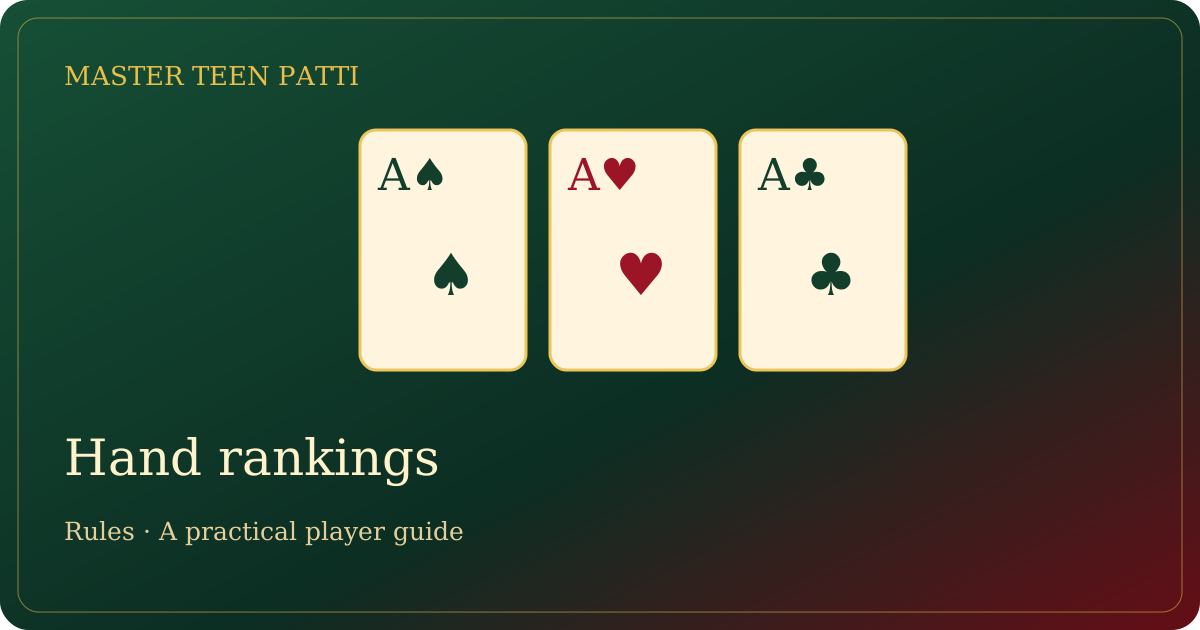
A hand has only three cards, but beginners often compare the highest card too early. Start by asking what the complete hand forms. Three of the same rank form a trail; three consecutive cards of one suit form a pure sequence. Next come a mixed-suit sequence, a colour, a pair and high card. That category decision comes before comparing card values. For learning, sort sample hands on a table without stakes. Name the category aloud and explain why another category does not apply. This exposes mistakes more clearly than memorising a list alone.
Work through a simple comparison
Imagine K♠ K♥ 5♣ beside A♣ 8♣ 3♣. The first is a pair; the second is a colour. Under classic category ordering, the colour wins. A pair of high cards does not override a higher category. Change the second hand to A♣ 8♥ 3♣ and it becomes high card, so the comparison changes. Looking at the whole hand prevents the ace from distracting you. A second useful check is 4♥ 5♥ 6♥: it has both a shared suit and consecutive ranks, so use its strongest valid category.
Handle the details separately
Once the categories match, compare within the category using the table’s stated rules. Equal pairs may require comparison of the third card. Equal high-card hands may require the second and then third card. Ace sequences deserve their own check: different rules can place A-2-3 and A-K-Q differently. Do not settle that detail from a picture of three cards or another app’s behaviour. Read the selected room’s rule panel.
Build a reliable learning routine
Write the six categories on a small note. Deal a few example hands, identify each, and check uncertain cases before you introduce a betting decision. Then read the Classic guide for the round structure. Rankings tell you how hands compare at a show; they do not reveal an opponent’s hidden hand, predict the next deal, or guarantee a winning decision. Keep practice and financial risk separate.
A practical 3 Patti sequence list
A “3 Patti sequence list” often means the complete hand-ranking list, although a sequence is only one category. Classify the whole hand before comparing individual ranks. These examples use ordinary Classic categories; a variant can change the result.
| Category | Example | Identify it |
|---|---|---|
| Trail | A♠ A♥ A♣ | Three equal ranks |
| Pure sequence | 4♥ 5♥ 6♥ | A run in one suit |
| Sequence | 4♣ 5♥ 6♠ | A mixed-suit run |
| Colour | A♣ 9♣ 4♣ | One suit without a run |
| Pair | K♠ K♥ 5♣ | Two kings |
| High card | A♠ J♥ 4♣ | No higher category |
Ace runs need a separate check. Pagat’s traditional rules put A-2-3 above A-K-Q. Do not treat that order as universal: read the selected table’s ranking for both runs and write its order beside your practice examples.
Tie-comparison practice: colour, pair and high card
For colours and high-card hands, compare descending ranks until one differs. For pairs, compare the pair first, then the remaining card. Work through these examples without stakes:
- Colour: A♣ 9♣ 4♣ versus A♥ 8♥ 7♥. The nines and eights decide after the tied aces.
- Pair: Q♠ Q♥ 3♣ versus Q♣ Q♦ 8♠. Equal queens leave the eight versus three.
- High card: K♠ J♥ 5♣ versus K♥ J♣ 4♦. Compare the final cards after kings and jacks tie.
If every compared rank matches, use the table’s tie procedure. A suit hierarchy or final-pot rule cannot be inferred from these examples.
Practise comparing two Teen Patti hands
Try a rule example
Compare Classic Teen Patti hands
Choose three cards for each player. All six cards must be different. This example uses a standard 52-card deck, no wild cards and no extra ranking for suits.
Choose six different cards, then select Compare hands.
The category order is Trail → Pure sequence → Sequence → Colour → Pair → High card. The chosen A–2–3 rule applies to both sequence types; K–A–2 is never a sequence here. Equal hand values remain a tie: this tool does not apply show-payment or side-show settlement rules.
Educational examples only. Random cards create a new local example; they do not simulate or test the linked APK, a real table or a dealing service. All selections and results stay in this page.
Rule source: Pagat’s Teen Patti hand rankings, which put A–2–3 first. The alternate order is an explicit assumption for comparison. Confirm the rule used by your chosen table.
Frequently asked questions
Does an ace always win?
No. The category is compared first, and a single ace does not beat a higher hand category.
Can I use Poker rankings?
Use the chosen Teen Patti table’s three-card rules. Five-card Poker terminology can lead to incorrect comparisons.
Sources & scope
Rules vary by table. See Pagat’s traditional Teen Patti reference for a documented rule set.
Published 13 October 2026. Updated 22 October 2026. Product claims not supported by file inspection are excluded. Read the editorial policy.