

A shared category is only the first checkpoint
Two hands both called Pair are not necessarily tied. Teen Patti tie breakers answer the next question: once the category matches, which ranks decide? A kicker is the remaining unpaired card in a pair hand. It matters only after the pair ranks match. Start with the complete hand-ranking guide if you still confuse categories; this article concentrates on comparisons within one category.
The nine exercises below are separate, invented examples using an ordinary 52-card deck, three cards per player and no wild cards. Every two-hand exercise contains six different physical cards. They are rank-comparison exercises, not betting advice or a prediction about hidden cards. Suit symbols identify the exact cards; we do not assign a default winning suit. These are educational examples for Master Teen Patti readers, not results obtained by running the selected APK.
Examples 1–3: trails, pair rank and the kicker
1. Compare the repeated rank in two trails
Player A: K♠ K♥ K♣. Player B: 9♠ 9♥ 9♦. Both hands are trails. A has three kings, so the repeated rank decides ahead of three nines. There is no spare card to compare and no need to add the card values. Two trails of the same rank cannot appear simultaneously in one ordinary deck: that would require six cards of a rank for which only four exist.
2. A stronger pair comes before the odd card
Player A: 10♠ 10♥ 2♣. Player B: 9♠ 9♥ A♦. A's tens outrank B's nines. The ace in B's hand does not compensate for the lower pair. Write the comparison as ‘pair tens versus pair nines’, then stop at that first difference. Looking for the single highest card too early would produce the wrong result.
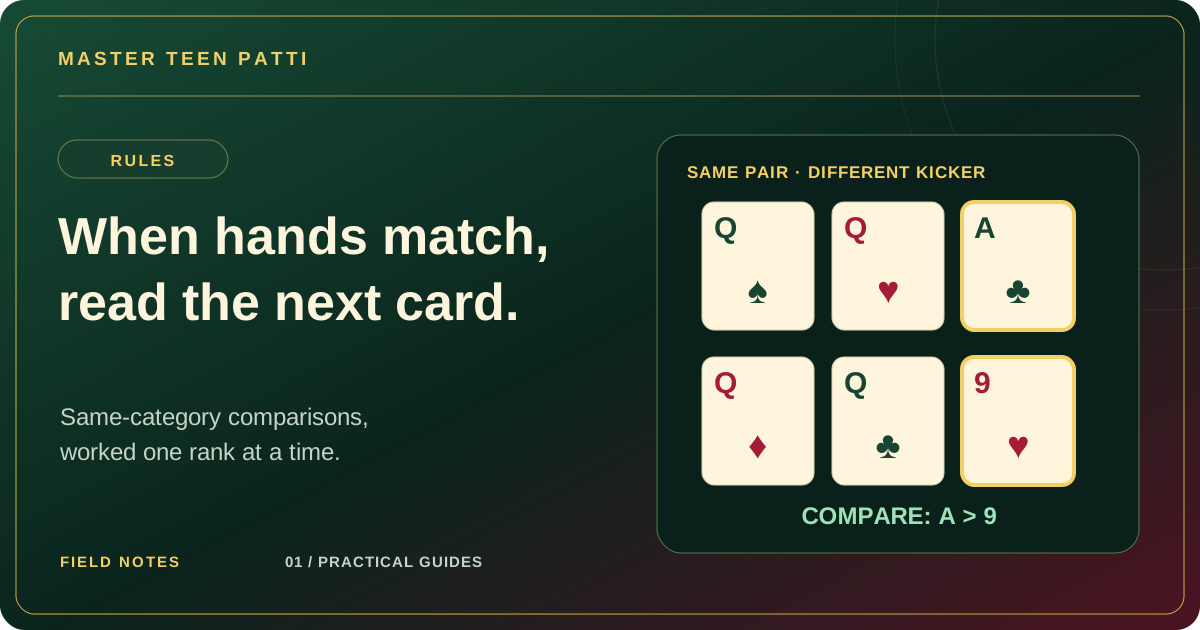
3. Equal pairs leave the kicker to decide
Player A: Q♠ Q♥ A♣. Player B: Q♦ Q♣ 9♥. All four queens are present once, so equal queen pairs are possible. Remove the matched pair ranks from the comparison: ace remains against nine. A has the higher kicker. The result comes from the spare rank, not from the suit of a queen or the order in which the cards were displayed.
Examples 4–5: compare colour and high card from left to right
4. An equal top card does not finish a colour comparison
Player A: A♥ J♥ 8♥. Player B: A♣ 10♣ 9♣. Each hand is a colour: one suit without three consecutive ranks. Sort the ranks downwards. The aces match, then jack beats ten, so A ranks higher. B's final nine never enters the decision. Hearts have not beaten clubs; the second card rank has separated the hands.
5. Sometimes only the third card separates high-card hands
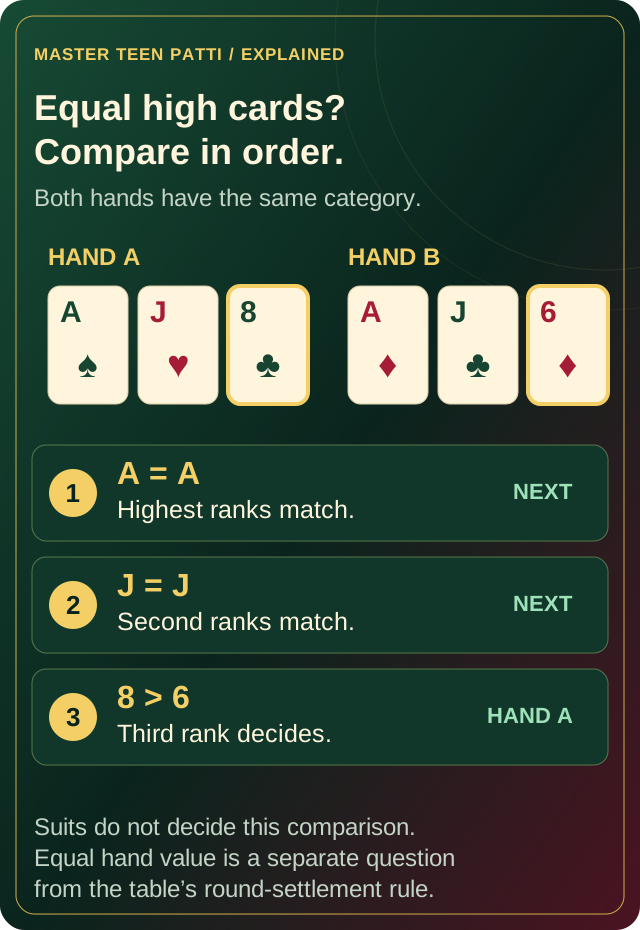
Player A: A♠ J♥ 8♣. Player B: A♦ J♣ 6♦. Neither hand contains a pair, run or colour. Compare ace with ace, jack with jack, then eight with six. A ranks higher at the third position. Reordering the display does not change that result. A useful practice note is ‘A = A; J = J; 8 > 6’: it shows exactly where the comparison ended.
Examples 6–7: compare the run, not a spare card
6. Two pure sequences still need a rank comparison
Player A: 7♠ 8♠ 9♠. Player B: 6♥ 7♥ 8♥. Both hands are pure sequences. For these ordinary runs, A ends at nine and B at eight, so A ranks higher. The hands share numerical ranks but not physical cards. The nine-high run wins without applying a spades-over-hearts rule. There is no kicker: all three cards form the run.
7. Mixed-suit sequences use the same ordinary run comparison
Player A: 9♠ 8♥ 7♣. Player B: 8♦ 7♠ 6♥. Both runs use mixed suits, so both belong to Sequence. A is nine-high and B eight-high. A ranks higher. Keep category and run order separate: do not describe a hand as a pure sequence simply because one suit appears in another player's cards. Each category is determined from that player's own three cards.
Example 8: put the ace-sequence rule beside the cards
Player A: A♠ 2♥ 3♣. Player B: A♦ K♣ Q♥. Both are mixed-suit runs, but their order needs an explicit ace rule. Under an A-2-3-first rule, A ranks higher; under an A-K-Q-first rule, B ranks higher. Do not simply label the first hand ‘three-high’ and assume the answer follows.
The sources illustrate why this check matters. Pagat's authored traditional rules place A-2-3 first. Octro's official learning page, in its opening Classic section, lists A-K-Q before A-2-3. They document different orders rather than establish one order for every table. Record the chosen table's wording and do not mix it with a rule from another format or another section. If the rule panel does not answer the question, leave this exercise marked conditional. A hand illustration cannot settle the missing rule.
Example 9: equal hand value is different from settling a round
Player A: Q♠ 9♥ 4♣. Player B: Q♦ 9♣ 4♥. Both are high-card hands with the same descending ranks: queen, nine, four. No rank remains to separate them. In these exercises the hand values are equal; we do not manufacture a winner from a suit, a seat number or who revealed first.
That does not automatically mean the pot is split. A table needs a separate rule for what happens when equal values meet in a particular comparison. In Pagat's documented ruleset, the player who did not pay for a final show wins when the hands are equal. In that same ruleset, an accepted sideshow with equal hands makes the requester fold. Those are procedure rules, not evidence that one queen-nine-four is intrinsically stronger.
Another format may specify a different settlement. Before applying a result, identify the procedure, its eligible players and its equal-hand clause. The table's statement must supply that step. Nothing in this article verifies the APK's settlement behaviour or imports Pagat's final-show procedure into its games.
Use a comparison record rather than a remembered result
For a new practice hand, write four lines: category, ordered comparison ranks, first differing rank, and unresolved house rule. If no rank differs, write ‘equal hand value’ and look up the separate settlement rule. This makes an explanation reproducible and exposes a skipped comparison. It also distinguishes a genuine equality from two hands that merely share an ace or a pair.
Check that your example uses no duplicate physical card across the two hands. Keep wild-card exercises separate: a substitution rule or natural-hand priority can change what must be compared. Use the table-rules checklist to record those conditions and the show and sideshow guide for the difference between procedures. Practise with paper cards or the educational comparer; identifying a ranking does not reveal opponents' cards or guarantee a profitable decision.
Frequently asked questions
What is a kicker in Teen Patti?
In a pair hand, the kicker is the third, unpaired card. Compare pair ranks first. Only equal pair ranks leave the kicker to separate the two hands.
Does a spade automatically beat a heart when hand ranks match?
No suit hierarchy is assumed in these examples. If every compared rank matches, the hand values are equal here; the selected table must specify its settlement procedure.
Do equal Teen Patti hands always split the pot?
No. Equal hand value and round settlement are different questions. Read the specific final-show, sideshow or other comparison rule; the article describes Pagat's procedure only as one documented ruleset.
Sources & scope
Checked on 26 October 2026. Pagat's original authored Teen Patti rules document rank comparisons, A-2-3-first ordering and the stated final-show/sideshow equal-hand procedures. Octro's official learning rules, in the opening Classic section, provide the contrasting A-K-Q-first order. The nine card exercises and the recording method are original educational examples. Neither source identifies this APK's implemented rules, and rules from different formats or sections are not combined into a universal rule.
Published 26 October 2026. Updated 26 October 2026. Product claims not supported by file inspection are excluded. Read the editorial policy.