

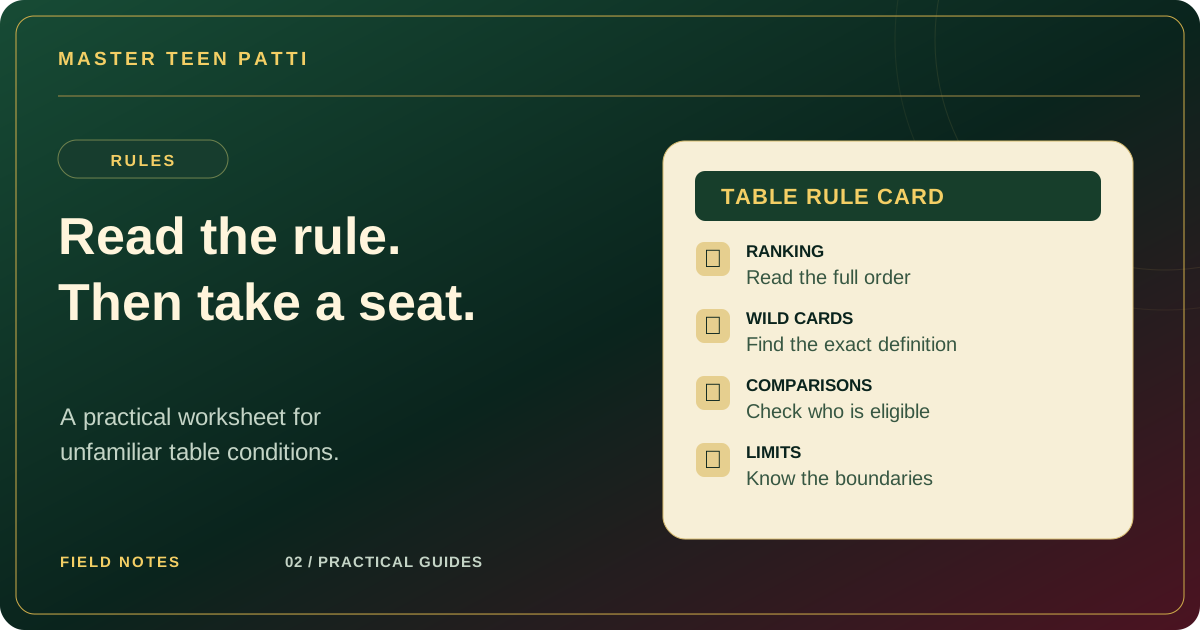
Read for meaning before deciding whether to join
A Teen Patti table-rules checklist helps answer what a table does, which actions it permits and which information remains missing. It is a rule-reading exercise, not a staking plan, an advantage system or a reason to join a paid game. Understanding a rule does not make an uncertain outcome predictable. You can complete the worksheet without entering a table or committing anything.
Start from the rule panel associated with the exact room or format you are considering. Record its name, the app version if visible, where the panel opens and when you read it. A lobby label may lead to several tables with different settings. This Master Teen Patti resource has not verified the selected APK's available modes, controls, limits or exit behaviour. Keep product-specific answers separate from the general questions below.
Check category order and the ace exception separately
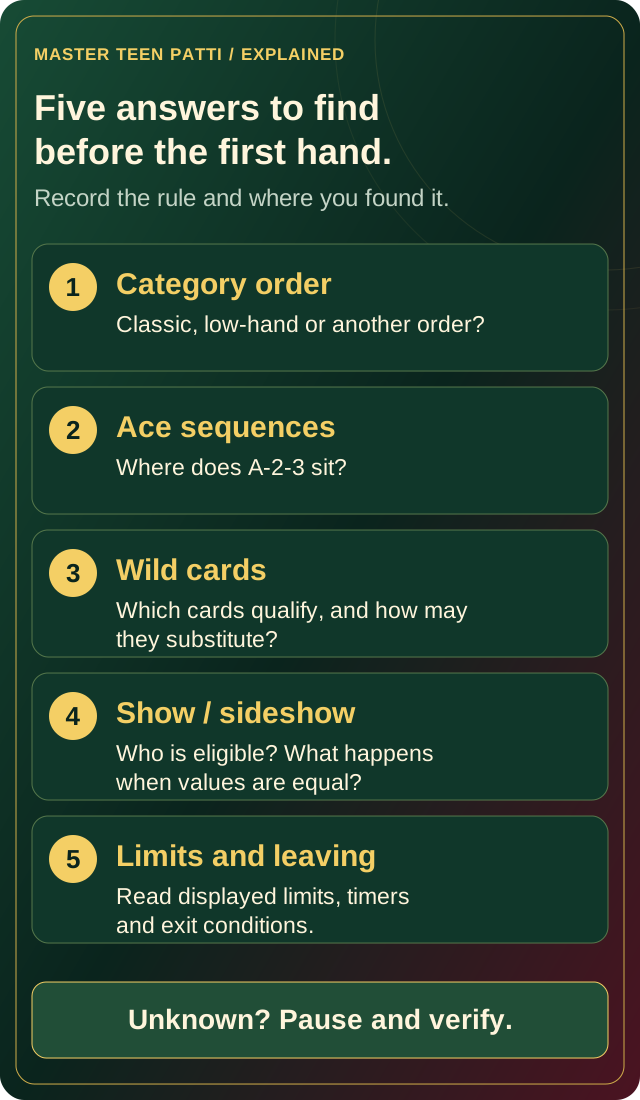
Find the category ladder rather than relying on a picture of a strong hand. Write its order as displayed, and establish whether the format is high-hand, low-hand or uses a separate scoring system. A guide to one format is not a replacement for the table's explanation. The hand-ranking article provides the ordinary Classic starting point.
Then look for how ace sequences are ordered. Pagat's traditional account places A-2-3 above A-K-Q; Octro's opening Classic learning section places A-K-Q first. Do not merge these into a single rule or choose whichever favours an example. A useful note states both the order and its source location. An ‘ace high’ label alone may not answer where A-2-3 sits.
Also check the treatment of equal categories and fully equal values. Ask whether the final comparison has a requester rule, shared result or another stated outcome. The tie-break examples explain why ranking two hands and settling a round are separate tasks.
Identify the variant and exactly which cards are wild
A variant name is a prompt to read more, not a complete specification. For a wild-card table, locate the rank or individual card that becomes wild, which suits qualify, when it is declared and whether it can change. Record what substitutions are permitted and whether a natural hand receives priority over an equal substituted hand. Mark any omitted point as unknown.
Octro's official variation document gives different mechanisms for Joker, AK47 and Lowest Joker. Those are examples of why one explanation cannot cover every variant; they are not a feature list for this APK. A statement that ‘jokers are used’ still leaves important evaluation questions unanswered.
Try a paper-only check with 9♣ 9♥ 4♠. With no wild cards it is a pair. Under an expressly stated rule allowing that four to substitute as a nine, it can be evaluated as a trail. If the eligibility of the four or the substitution rule is unstated, the stronger interpretation remains conditional. Keep the physical hand and evaluated hand as two separate notes. See the variant comparison guide for the wider distinction.
Read show and sideshow as separate permission checks
Locate the remaining-player requirement, blind/seen status, permitted requester and any cost for each comparison. Then find acceptance, refusal and equal-hand consequences. Do not infer that a visible button is usable in every state, or that a private comparison and final show share the same conditions.
The published sources differ here too. Pagat's documented sideshow requires all active players to be seen. Octro's Classic explanation instead specifies a seen requester, a seen previous player and other players still active. These conditions belong to their respective descriptions; neither can be substituted for the unknown rule of a different app.
For a paper exercise, label three active players: A seen, B seen, C blind. Record that information without making a request. A rule requiring everybody to be seen and a rule requiring only the eligible pair to be seen can answer differently. If the actual panel does not resolve that state, write the question down. The existing blind, seen and show guide explains the terminology.
Separate table limits from your own stopping boundary
Find what the boot represents, how the current stake is defined and whether displayed controls show an additional amount or a total. Check any minimum, maximum, pot cap or blind-turn limit, including what happens when a limit is reached. Copy the table's actual wording and units. No number from another app's help page establishes this room's limit.
Read exit behaviour as carefully as entry. Distinguish packing the current hand, leaving a table and closing the app. Ask what a timeout or lost connection does, whether a queued next-hand entry exists, and what happens if you leave during an unresolved round. These are questions, not claims that the APK has any particular automation or recovery feature.
A software cap does not replace a personal time or spending boundary. If a rule or exit consequence remains unclear, you can decline the table rather than learn it through a paid action. This checklist does not recommend a bet size or further play. Keep any personal boundary separate from what the table technically permits.
Complete a worksheet with evidence and unknowns
Use exact answers and a source location for each row. ‘I have played a similar room’ is background knowledge, not evidence for this table. If a detail is missing, keep the blank visible instead of replacing it with a familiar default.
| Question | Actual answer | Evidence location | If unclear |
|---|---|---|---|
| Which category order and ace order apply? | ____ | Rule panel / passage: ____ | Do not assume Classic or an ace order. |
| Which cards are wild, and how may they substitute? | ____ | Declaration / variant rule: ____ | Keep the hand evaluation conditional. |
| Who may request show or sideshow, and when? | ____ | Eligibility / state rule: ____ | Do not infer permission from a label. |
| How are equal values and refusals handled? | ____ | Comparison procedure: ____ | Do not assume an automatic split. |
| What limits, timeout and exit consequences apply? | ____ | Table settings / help: ____ | Do not join until the consequence is understood. |
Keep a dated private copy. A screenshot can help preserve wording, but remove account identifiers and unrelated notifications from any copy you share. A complete worksheet is a record of what you found, not a certificate that a game is fair or a particular feature will operate as described.
Resolve a missing rule without inventing an answer
Turn each unknown into a precise question. Instead of ‘How does this table work?’, ask ‘This room names a joker rank but does not state natural-hand priority; which rule resolves equal evaluations?’ Include the table name, version if known, the relevant passage and the state you are asking about. A rule question should not include a password, code or payment credential.
Use a verified product channel if one is available. Keep the answer with the panel you originally read, and check whether it actually resolves the same format and situation. If explanations conflict, do not combine convenient fragments into a new rule. Leave the question unresolved and choose not to participate until it is clear. Revisit the worksheet after a material rules update; a new table name, app version or notice can require fresh reading without proving that every rule changed.
Frequently asked questions
What should I check first in Teen Patti table rules?
Identify the exact table and format, then record its category order and ace-sequence order. Continue with wild cards, comparison eligibility, equal-hand outcomes, limits and exit behaviour.
Can I apply one app's sideshow rule to every table?
No. Published rules can specify different eligibility conditions. Read the actual table's requirements for the requester, other player, active-player state, cost, refusal and ties.
Does completing this checklist improve my chance of winning?
It helps you identify what a rule means and what remains unknown. It is not a betting strategy or a guarantee of profit, fairness or an outcome. You can use it without joining a game.
Sources & scope
Checked on 26 October 2026. Pagat's original authored Teen Patti rules provide one documented traditional ruleset. Octro's official learning rules, opening Classic section, provide the separately attributed ace-order and sideshow examples. Octro's official variations document supplies distinct wild-card mechanisms. The worksheet and paper exercises are original. These sources describe their own rules; they do not establish the selected APK's modes, limits, buttons or exit behaviour.
Published 26 October 2026. Updated 26 October 2026. Product claims not supported by file inspection are excluded. Read the editorial policy.